
Checking dental panoramic X-ray systems with the RaySafe X2: how does it work?
In a previous blog about measuring intraoral X-ray systems, we briefly wrote about the updated regulations regarding the registration of dental X-ray systems. Where previously a notification obligation applied, all devices must now be registered. Checking dental X-ray systems is therefore becoming increasingly intensive. There are practical tools you can use for this. In this blog, we will discuss measuring radiation with the RaySafe X2 in dental panoramic X-ray systems, using the panoramic holder.
R/F and DENT sensor
There are two RaySafe X2 sensors that are suitable for this application: the R/F sensor and the DENT sensor. What is the difference between these two?
In terms of design, the sensors are very similar. The difference lies in the measuring range.
- The DENT sensor measures from 40 to 130 kVp.
- The R/F sensor measures from 40 to 150 kVp.
The trigger level also differs for dose rate measurements: - The R/F sensor triggers at 50 nGy/s.
- The DENT sensor triggers at 1 µGy/s.
The DENT sensor is a derivative of the R/F sensor and more focused on dental applications.
How do you use these sensors with panoramic systems?
For this, the panoramic holder was developed. Both the DENT and R/F sensors are suitable for use in this practical tool for OPG systems.
It is important when measuring dental panoramic X-ray systems that the measuring sensor is positioned correctly in the middle of the radiation beam. In practice, this often happens with tape or other creative solutions. The panoramic holder offers a more reliable and easier way to do this. You can easily position the holder on the X-ray machine using the fixation strap.
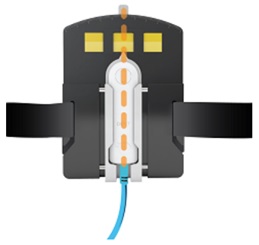
By using a piece of light-sensitive film, you can determine the center of the beam. Using the sliding dimension on the panoramic holder, you can adjust the position of the sensor accordingly.
This way you can reliably and practically measure radiation in dental panoramic systems.
Do you also want to measure leakage radiation? Then use the Survey sensor of the RaySafe X2. There is also a possibility to measure mAs.
