
The smallest and most vulnerable patients within the hospital are cared for in the incubator. These newborns are treated in the incubator unit due to premature birth or other reasons. A stable environment in the incubator is of paramount importance. There are several standards for checking incubators: IEC60601-2-19, -20 and -21. While we extensively follow the IEC standards for other purposes such as electrical safety, we do not always see this reflected in the checking of incubators.
Good performance of an incubator contributes to the development of the child. Because newborns are unable to express their feelings about the temperature, airflow, or noise in the incubator, you should check this carefully.
A number of issues are indicated in the relevant standards. Also follow the instructions of the manufacturer of the incubator in question. We also check the following:
- Temperature
- Relative humidity
- Airflow
- Noise
- Skin temperature probe
You perform the main measurements at 5 points in the incubator at a height of 10 cm; see the following overview from the standard.

Temperature
First of all, measure the warm-up time of the incubator. Also check that the set temperature is not exceeded by more than 2 degrees Celsius during warm-up. Verify all surfaces and check that they do not become too hot.
After the warm-up time, it is important to measure the stability and average incubator temperature. Does the temperature remain within the set range in the time frame of one hour? Is the temperature evenly distributed throughout the incubator chamber?
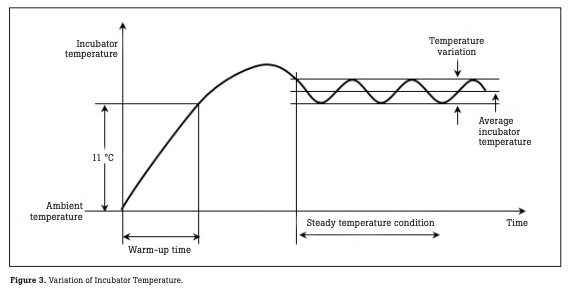
In addition to the warm-up time and the average incubator temperature, also check the measurement of the skin probe. When checking radiant warmers, you can also check the distribution of the temperature over the measuring points.
Humidity
Good conditioning of the relative humidity is important for the airways and skin of the newborn. Check the accuracy of the relative humidity. Is it within +/- 10% of the measured value?
Airflow
High airflows cause moisture and temperature loss. Measure the airflow in the incubator and check whether it is equal to or less than 0.35 m/s.
Noise
A lot of noise disrupts the development of newborns. Check that the noise level inside the incubator remains below 60 dBA. Also check the correct alarm settings of the incubator.
Checking incubators therefore goes beyond just a few temperature measurements. Use the standard as a starting point and follow the manufacturer’s instructions.
