
It is clear that non-invasive ventilation has taken a prominent place in respiratory strategies. Within this category, there are still ways to optimize, for example, through synchronized non-invasive ventilation.
NIPPV is positioned between invasive endotracheal ventilation and nasal CPAP. Synchronizing NIPPV breaths with spontaneous breaths has advantages. Synchronization with the patient’s spontaneous breaths (SNIPPV) results in lower work of breathing, reduced need for intubation, and better outcomes after extubation compared to NIPPV and nasal CPAP (V. Dumpa & V. Bhandari, 2021).
External trigger with respiration sensor
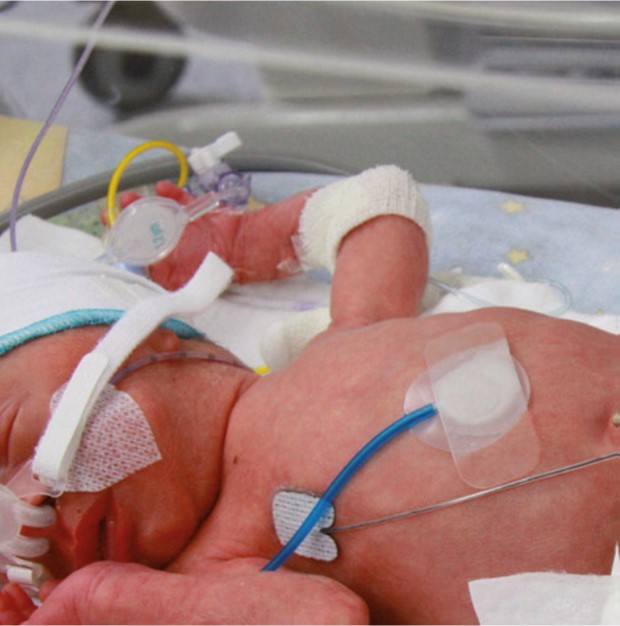
Spontaneous breaths in the newborn are accompanied by characteristic movements of the abdomen. By placing a sensitive Graseby respiration sensor on the abdomen, the ventilator can accurately detect the breathing movements. This occurs via pressure changes in the respiration sensor, which are detected by a pressure sensor in the ventilator.
Because the respiration sensor is filled with a layer of foam, it returns to its original shape after each breathing movement. The software filters out disturbances or artifacts. In this way, mechanical breaths are reliably synchronized with the patient’s spontaneous breaths without disturbing automatic triggers.
Inspiratory and expiratory trigger
Unique to this method is that both inspiration and expiration can be triggered. The respiration sensor detects the beginning and end of spontaneous breathing. If the abdominal movement stops or the signal does not increase further, the expiration starts and the mechanical inflation is automatically terminated — even if this is earlier than the set inspiratory time. In this way, the patient retains maximum control over the ventilation.

Apnea detection
In the event of apnea, there is no abdominal movement. The respiration sensor registers this and automatically activates the set back-up breaths. This prevents saturation drops and excessive alarming. The device can also display the number of apneas per hour.
With SNIPPV, external triggering is focused on synchronization. With nasal CPAP, the focus is more on apnea detection. External triggering is possible with the EVE, EVA and Sophie+ ventilators from Fritz Stephan.
